For UK manufacturers, sustainability has moved beyond a compliance exercise. Rising energy costs, increasing customer expectations, pressure from supply chains, and emerging reporting requirements mean that sustainability is now directly linked to profitability and competitiveness. Whilst some of this is enforced via EU rules applying to almost anybody supplying into the trading block, MAKE UK reports that sustainable manufacturing companies see 40% increased profit margins and 30% increased competitiveness. With energy prices high and conflicts showing no real signs of abating, sustainability enters the boardroom not as a social responsibility, but as a necessary achievement for remaining competitive.
Anthesis works with many companies looking to understand how to capture better data about their sustainability. Manufacturers who are looking to get serious about sustainability are using tools and business systems, including manufacturing ERP software, to make capturing, understanding and reporting on their data easier. Ease of reporting can make those hunches you have easier to prove and justify small changes as well as bigger ones.
Sustainability now goes beyond energy consumption, carbon emissions and ESG reporting. Businesses now recognise workforce diversity, gender pay gap reporting and wider corporate social responsibility initiatives as important components of their sustainability strategy.
Whilst there are many detailed topics to discuss, this blog serves as a starting point for considering what sustainability data exists across your business, and how a single connected ERP system like IFS Cloud can help bring that data together to support better decision making and contribute to profitability.
Reducing waste with better visibility and stock management
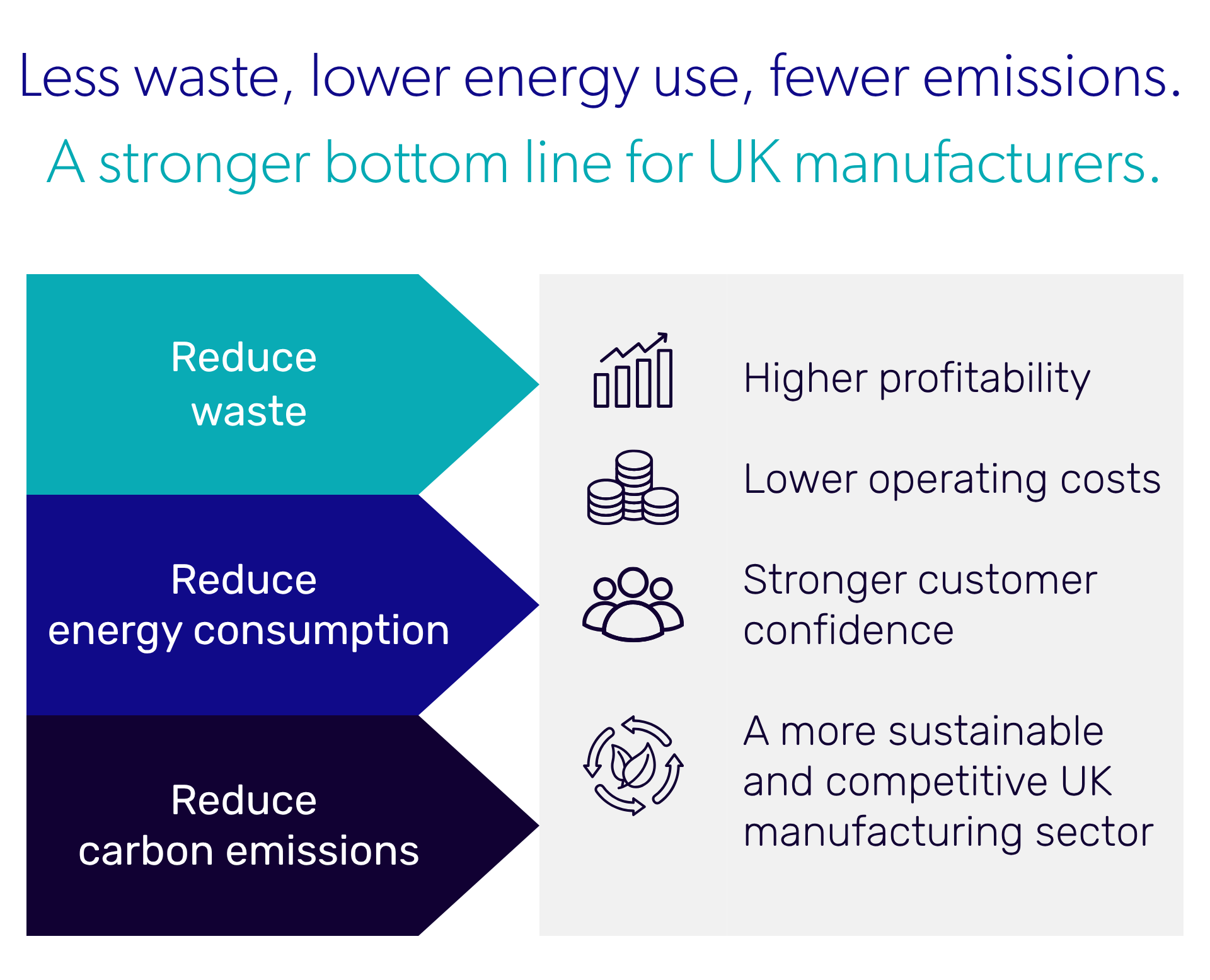
Perhaps the most obvious priority for a manufacturing operations decision maker is reducing waste. For the manufacturers we work with, reducing waste often begins with better visibility of inventory.
When stock management, warehousing and production planning are disconnected, materials approaching their expiry date can be missed despite still being suitable for use. By enforcing FEFO processes and providing a single view of inventory across the business a connected ERP system helps ensure valuable materials are utilised before they become waste.
A single system allows both warehousing and manufacturing planning to see what is in stock and needs utilisation, minimising those ‘slipped through the cracks’ moments where valuable stock may need re-testing by the quality control team, or worst case, requiring disposal and wasting both funds and effort to replace the product.
Improving efficiency to lower energy consumption and control costs
Over the recent years energy consumption has been a key topic for all manufacturers, with 90% of UK manufacturers reporting having seen their energy bills increase since 2022. Manufacturers are therefore always looking for ways to reduce the energy consumed per unit.
In many UK SMEs, limited capacity manufacturing resources are planned in the heads of extremely experienced shop-floor supervisors and staff. How much fits exactly into one oven or curing tank is often the knowledge base of those that have been doing the same job for 30 years. But what happens when that person retires, or leaves the business?
Having connected manufacturing data management tools that are capable of understanding capacity of batch resources and the rules around planning are critical for businesses to make sure they do not lose energy efficiencies in the form of knowledge that has been around for decades.
Better planning and reduction of changeover time when machinery is still running are critical to ensuring that energy consumption stays as low as possible. With digital transformation taking care of the planning and execution – your procurement team can get out there to find the lowest possible prices for powering your factory, capturing each quote to ensure that they get the best possible deal.
Not just planning of manufacturing either – with the cost of fuel as it is, maximising trailer loads and deliveries has never been more important. A modern manufacturing software system with visibility of what is happening at goods out and what is coming off the line allows manufacturers to fill vans and trucks efficiently, minimising the cost of each single delivery.
Better reporting to reduce carbon emissions
Reporting on carbon emissions can be complex. From capturing supplier data to maintaining setup consumption and running costs, each individual data input must be analysed, captured and reviewed, before being incorporated into the calculations used to measure CO2 emissions and provide an accurate view of carbon footprint and sustainability performance.
If each of these items is owned by a different person, or sat in a different spreadsheet, collating this data becomes a task in itself, requiring either dual entry into more than one place, or lookup functions that are absolutely reliant on the team knowing not to make edits to crucial Excel documents stored within a shared folder.
The value of connected reporting on carbon emissions extends far beyond producing a sustainability report at the end of the year. When emissions data is captured directly from operational processes within a connected ERP system, manufacturers gain a real-time understanding of where carbon is being generated across the business.
This visibility allows organisations to identify trends, measure the impact of improvement initiatives and make informed decisions that reduce emissions over time. Rather than relying on historic spreadsheet data, manufacturers can use accurate reporting to drive meaningful and measurable sustainability improvements.
The problem with sustainability spreadsheets
Many manufacturers still rely on spreadsheets to track emissions, energy usage, waste volumes and sustainability targets. Whilst spreadsheets can be useful for analysis, they create significant challenges when used as a primary reporting tool.
Different departments often maintain separate versions of the truth, resulting in duplicated effort, manual data collection and reporting delays. As sustainability requirements increase, spreadsheets simply can’t provide the visibility required across production, warehousing, procurement and logistics operations.
A connected ERP solution for manufacturers helps bring together sustainability, inventory, production and logistics data into a single source of truth, allowing crucial metrics to be captured directly from operational processes.
Moving beyond spreadsheets: a connected sustainability strategy
The most sustainable manufacturers are increasingly the most connected manufacturers. When inventory, production, planning, procurement, logistics and sustainability data are managed within a single platform, organisations gain the visibility required to reduce waste, improve efficiency and make informed decisions.
IFS Cloud ERP has capabilities for the sustainability data reporting requirements of most SME manufacturers today. Within a single instance, single source of data, the system allows the business to track and manage the production process from initial sales & operations planning right through to delivery to customer and sustainability reporting.
Rather than relying on spreadsheets and disconnected data sources, IFS Cloud enables manufacturers to capture sustainability-related information directly from operational processes.
From monitoring carbon emissions and manufacturing performance to optimising transport utilisation, packaging consumption and shipment consolidation, the platform provides the visibility needed to make better decisions. The result is a more efficient and profitable operation, with lower waste, improved reporting confidence and measurable progress towards sustainability goals.
Written by Oliver Franks, Solutions Consultant at Anthesis Ltd.
Ready to take the next step towards your connected sustainability strategy with a modern ERP? Speak to us today to find out more.